

In 2019, I set up a business that showed startups how to strategically scale entire businesses with people.
In order to scale rapidly, I knew they needed to master Talent Acquisition rather than relying on recruitment agencies to provide candidates. I just had to prove it.
Working with 10 clients in the first year, we proved the hypothesis and then doubled down on the thing that mattered most: strategy.
Hiring people is one thing, but the plan won’t work if you don’t have the right strategy and the right definition of the skills required to get there.
Fast forward to today, and having spent years at the forefront of startup hiring, we are seeing a massive shift.
We used to help startups hire humans. Now, increasingly we are helping them hire “robots” in the form of AI.
What has Talent Acquisition been doing up to now?
Most people think Talent Acquisition is just recruitment with a different name. It isn’t.
Talent Acquisition is a field that starts with strategy and ends with execution. Recruitment is simply an activity that happens within that field.
Recruitment will get you people, but Talent Acquisition makes sure those people can help the company achieve its objectives.
Up until now, Talent Acquisition activities have revolved around headcount planning, succession planning and people.
The solution has predominantly been human. That is changing.
How Talent Acquisition has changed in 2026
Startups are starting to build their businesses from the ground up with AI rather than humans.
Founders are realising that AI isn’t perfect and still needs skilled people to direct it, challenge it and sense-check the output. As a result, Reedmace Talent is seeing a growing number of early-stage startups looking to attract fractional C-level experts with deep experience in their subject area.
Startup CFOs, for example, are worth their weight in gold for businesses seeking investment. Some of the more forward-thinking CFOs are even offering solutions to help founders build and oversee AI agents so that much of the important work is correctly automated from day one.
This shift is allowing startups to grow faster than before with far fewer permanent hires.
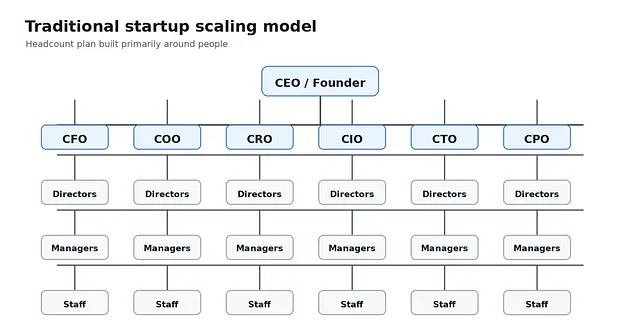
In the past, Talent Acquisition would look at the skills gap between where a startup was and where it needed to get to. It would then create a headcount and succession plan based primarily on people.
A traditional structure might have hired 25 people and looked something like this:
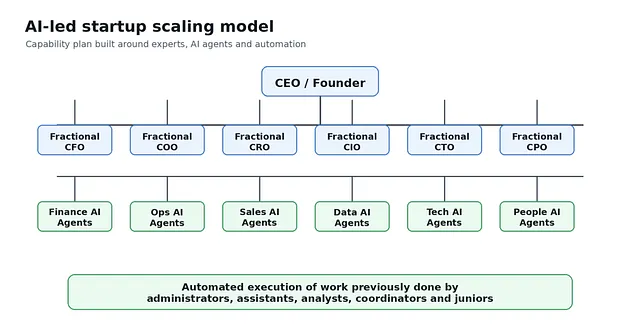
Whereas AI-enabled structures may only need to hire the board and spend the rest on AI, like this:
The attraction is obvious.
AI doesn’t need a salary, pension, holiday entitlement or office space. It can work around the clock and complete many of the tasks that previously sat with junior employees.
The challenge is that AI still needs experienced people to tell it what to do, sense-check the output and make important decisions when the stakes are high.
How Reedmace Talent is responding
AI may have changed the answer, but it hasn’t changed the underlying problem. Founders want to scale quickly but don’t know what skills they need, or how to best acquire them. Reedmace Talent has already been designing the strategy and skills layer for startups for years.
We define what the business needs to do to grow. Then we translate that into what kind of capability is needed before teaching them how to acquire the skills and talent as they grow.
We have literally just finished helping an AI software company hire a fractional CFO.
Like a fair few of our up-and-coming customers, they are using AI agents and AI systems to build the business. It is mainly the founders, the AI and the agents at this stage. Startups like this, with huge ambition, expect to achieve a great deal with AI, but before they can implement it properly, they need a plan.
Historically, that would have become a headcount plan and job descriptions built around humans.
Now, it has to encompass both humans and robots.
What future jobs will exist?
In bigger businesses, you may have the board, then managers, then AI agents doing much of the work underneath.
In smaller businesses, you might just have the founders, the board-level experts and AI agents, with maybe some admin support around them.
The major shift is that the junior skills coming into the business may no longer be needed in the same way.
That is a big challenge for junior people. They need to find jobs and skills that cannot be replaced in this manner. Because this shift is already happening.
Companies of the future will be built around a smaller number of very experienced people managing AI agents that do the work.
That is where startup hiring is heading.
The old question was: “Who do we need to hire?” The new question is: “Do we need to hire at all, or can a robot do it?”
About the author
Dan Corcoran is the founder of Reedmace Talent. He helps startups hit funding and growth milestones by turning hiring from a bottleneck into a capability. Rather than recruiting for companies, Reedmace Talent teaches startups how to hire properly, so growth plans can actually be executed. Dan
Recent Comments