
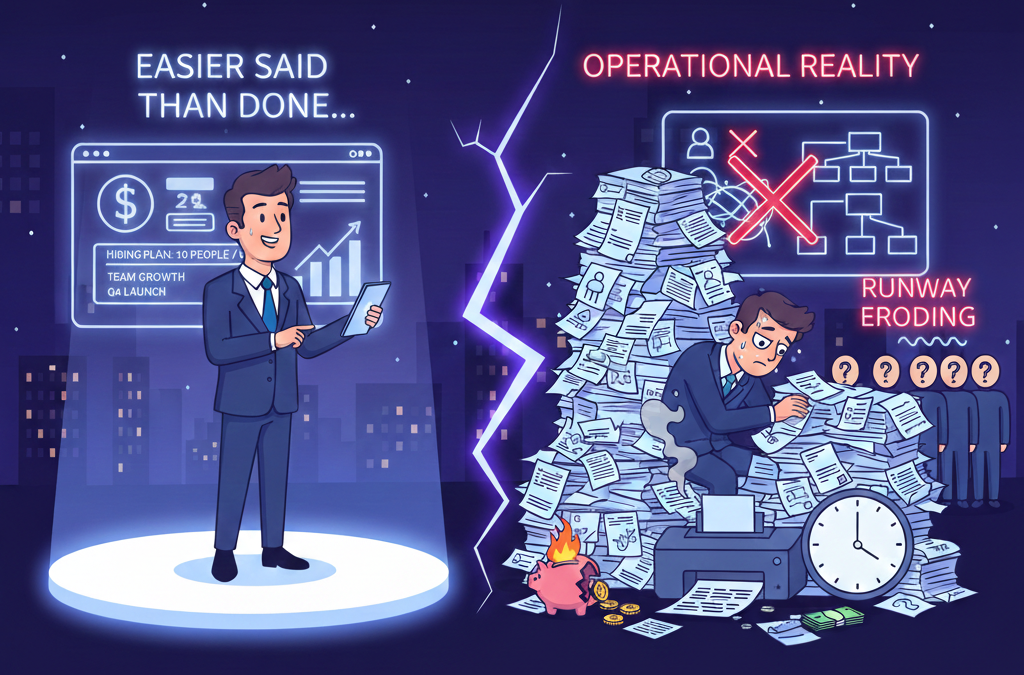

Hiring is one of the easiest things to describe in a pitch deck, and one of the hardest things to execute once the money lands.
A deck can say “we will hire 10 people” and still raise investment, particularly if the market story, traction, or growth narrative is strong. The operational reality is different. If the founders have never hired or interviewed at volume, hiring 10 people in a year can quickly become a nightmare that slows delivery and quietly erodes runway.
This article looks at how UK startups typically present hiring in pitch decks, using real public examples, and contrasts that with what actually has to happen once execution begins. It also draws on Reedmace Talent’s work with funded startups, where hiring plans move from slides into reality.
How hiring usually appears in pitch decks
1. Use of funds with implied headcount
The most common pattern is a use‑of‑funds slide that allocates capital to “team growth”.
This often includes:
- a total number of hires over 12–18 months
- a functional split, such as engineering, product, sales, and operations
- occasionally the first one or two priority hires
This approach is widely visible across Series A pitch deck collections and guidance from firms such as Carta and PitchDeckHunt. It communicates intent and scale, not execution detail.
At pitch stage, this is usually sufficient.
2. Milestones that assume hiring will happen
Another common pattern is milestone slides that imply hiring without spelling it out.
Typical examples include:
- shipping a new product version by a certain quarter
- expanding sales capacity
- entering new markets
Hiring is embedded as an assumption inside delivery. This can be seen in publicly reviewed decks and in TechCrunch’s teardown of Careerist’s Series A deck, which raised $8m while focusing almost entirely on traction and growth rather than hiring mechanics.
Strong traction can outweigh thin hiring detail when capital is being raised.
3. Org chart snapshots
Some decks include a simple “now vs later” organisational view.
These usually show:
- founders and the current team
- missing leadership roles, such as CFO or Head of Sales
- additional teams that appear post‑raise
This is a signalling device. It shows where the company expects to go, not whether it knows how to hire into that structure. It also doesn’t factor in people leaving, training required or succession planning.
4. The real pitch-deck hiring plan lives in the financial model
While decks vary widely, financial models are far more consistent.
Guidance from firms such as Carta, Kruze Consulting, Burkland, EA Partners, and Parallel all treat headcount as one of the primary drivers of burn and runway.
Typical Series A models include:
- headcount by month or quarter
- start dates and ramp assumptions
- fully loaded costs
- runway and scenario analysis
At seed stage, these models are often founder‑built. As companies approach Series A, they are commonly rebuilt or stress‑tested with CFO or fractional CFO support, because headcount assumptions stop being theoretical and start determining survivability.
The execution gap: raising money vs hiring people
Pitch decks rarely reveal whether founders can actually hire at pace.
That gap only becomes visible once execution starts.
Founders who have hired before usually have an intuitive understanding of:
- how long hiring actually takes
- how much founder time it consumes
- how often roles need redefining
- where decision‑making slows down
First‑time founders often underestimate this.
Hiring ten people in a year requires:
- repeated role definition
- structured interviewing
- consistent decision‑making
- significant time away from product and customers
This gap is not hypothetical. In Reedmace Talent’s work with funded startups, assessing whether founders and managers have experience attracting, interviewing, and selecting talent is a core part of early engagement, because lack of capability shows up quickly once hiring begins.
The cost mistake that quietly damages runway
Most early financial models include salary and employer costs. Many omit the cost of acquiring talent.
Two categories are commonly missed:
- Recruitment fees
If a company defaults to recruitment agencies post‑funding, fees are commonly structured as a percentage of first‑year salary. Legal commentary and agency contracts show this can vary widely and can be material at scale.
The issue is not the exact percentage. It is that many models assume zero cost until the problem appears in cash flow.
2. Candidate attraction and tooling
Advertising spend, sourcing tools, and employer branding effort are often left out of early models. In Reedmace Talent’s delivery work, external advertising and candidate attraction is always treated as a budgeted cost, because it directly affects runway.
Ignoring these costs makes a hiring plan look cheaper than it is.
Location and talent availability as execution constraints
Location rarely needs a dedicated pitch slide. It becomes critical however in delivery.
Hiring speed and cost are affected by:
- where the company is based
- whether remote hiring is viable
- whether the required skills are scarce
- whether training pipelines exist
For specialist roles, particularly in deep tech or advanced software, Reedmace Talent routinely sees hiring plans require market mapping, targeted search, and role redefinition rather than relying on inbound applications.
None of this needs to be solved in a deck. It does need to be recognised in execution.
CFO involvement arrives when hiring becomes real
As companies approach Series A, hiring plans and runway become tightly coupled. At that point, finance capability is often strengthened, with the addition of a full time or fractional CFO. Sometimes before fundraising, sometimes (alarmingly!) after investment has already landed.
Reedmace Talent has worked with companies in both scenarios, including cases where hiring assumptions were tightened post‑investment because execution was harder and slower than expected.
A minimal hiring plan that holds up in reality
A hiring plan does not need to be heavy to be credible.
As a minimum, founders should be able to articulate:
- how many people they plan to hire
- in what order
- over what timeframe
- at what fully loaded cost
- who owns execution
In Reedmace Talent’s client work, this is often formalised into a short headcount plan, documented hiring process, and playbook that allows hiring to be repeated without burning founder time.
Closing thought
A high‑level hiring overview can be enough to raise capital but hiring at pace requires operational capability in Talent Acquisition.
The earlier that gap is acknowledged, the easier it is to close.
And if you are unsure on how ready you are, reach out to a business like Reedmace Talent that can assess and rate your Talent Acquisition Readiness prior to investment.
About the author
Dan Corcoran is the founder of Reedmace Talent. He helps startups hit funding and growth milestones by turning hiring from a bottleneck into a capability. Rather than recruiting for companies, Reedmace Talent teaches startups how to hire properly, so growth plans can actually be executed. Dan is also a startup mentor, NED, and advisor to UK incubators and accelerators.
Let’s Connect
If you enjoyed this article and want to connect with me, feel free to follow me on LinkedIn where I regularly post startup related content
Recent Comments